

Questions to Ask About Pay and Contracts When a Remote Employer Is Abroad
Many remote roles are open to people in more than one country. That widens the search, but it also raises practical questions that a local job never does. Who actually employs you. Which currency you are paid in. Whose rules govern your contract. Asking early saves surprises after you sign.
Who is the legal employer
A company hiring across borders usually takes one of a few routes. It may have its own entity in your country and hire you directly. It may use an employer of record, a third party that employs you on the company's behalf and runs payroll locally. Or it may engage you as an independent contractor who invoices for the work. Each route changes how taxes are handled, which benefits you receive and how the relationship can end. Ask the recruiter which route applies to your location before you reach the offer stage.
How and when you get paid
Ask which currency your pay is set in and who carries the exchange rate risk. Ask how often you are paid and through which channel. If you are a contractor, find out whether you invoice monthly, what payment terms apply and whether transfer fees come out of your side. Small details here add up over a year. It also helps to ask whether pay reviews follow your local market or the company headquarters.
What the contract covers
Read the notice period, the governing law and the clauses on equipment and intellectual property. Check whether public holidays follow your country or the company's. If anything is unclear, ask for it in writing.
Finding roles open across borders
Listings marked Global are a common starting point for this kind of search. On Best Remote Jobs the location menu includes Global alongside individual countries. When the screenshot below was taken, the Global results included a Senior CX Platform Engineer role at GitLab and a Software Engineer 3 role at MongoDB, and the list changes as new roles are posted.
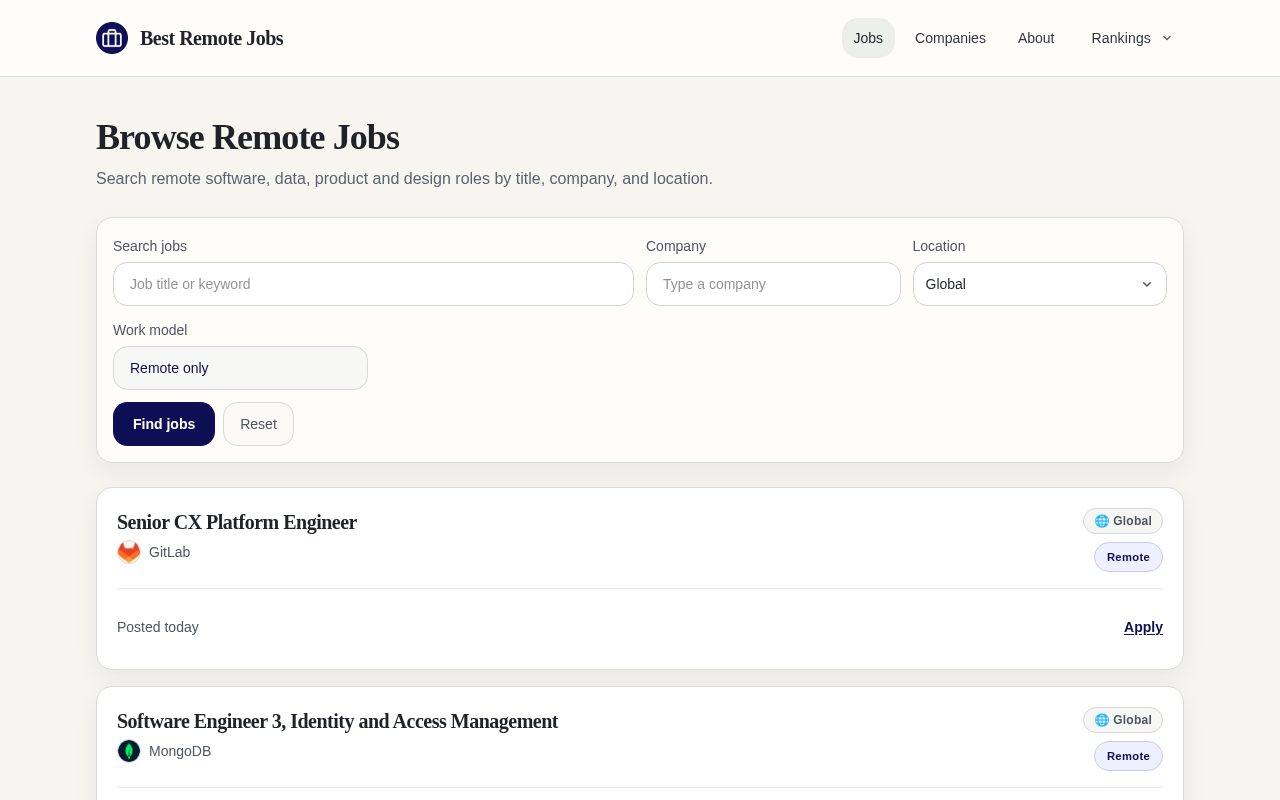
Remote roles filtered to the Global location on Best Remote Jobs.
A Global label means the posting is not tied to one country, but the company may still have limits on where it can employ people. Treat it as a reason to ask, not as a guarantee.
Keep your own records
Save copies of the offer, the contract and any messages about pay or location. If you move countries later, tell the employer first, because your location can change which hiring route is allowed. A clear paper trail makes those conversations much easier.