

Building Invoice and Receivables Aging Models for Finance Reporting
Finance teams ask a short list of questions about money that customers owe. How much is outstanding today. How much of it is late. Which customers are slipping. The answers live in billing and accounting systems, but those systems store invoices and payments as separate events. Turning those events into an aging report is a common analytics engineering task, and it rewards careful modeling.
Start with the invoice grain
The base model should hold one row per invoice. Each row carries the customer, the issue date, the due date, the currency and the original amount. Payments, credit notes and write offs belong in their own model at one row per application, meaning one row each time a payment or credit is matched to an invoice. Keeping these apart lets you rebuild the open balance for any date instead of trusting a single status field that the billing tool overwrites.
Calculate the balance as of a date
An aging report is always as of a specific day. Join applications to invoices, keep only the ones dated on or before the reporting date, and subtract them from the original amount. What remains is the open balance on that day. Days past due is the gap between the reporting date and the due date. Buckets such as current, one to thirty days and thirty one to sixty days are then a simple case expression. Store the bucket boundaries in a small mapping table so finance can change them without a code change.
Snapshot for trend lines
Finance usually wants to see whether late balances are growing. Rebuilding every past month from raw events works, but a monthly snapshot table is easier to query and easier to explain. Record the open balance by customer and bucket at each month end and never update old rows. If an old payment is backdated, note the restatement rather than silently changing history.
Agree on the edge cases
Partial payments, disputed invoices, refunds and multi currency customers all need a written rule. Decide with finance whether a disputed invoice stays in its bucket or moves to a separate line, and which exchange rate applies to the balance. Put those rules in the model documentation next to the columns they affect.
Where this work shows up in hiring
Receivables and close reporting appear in finance focused analytics engineer roles. A keyword search for finance on Analytics Engineer Jobs lists current openings with that word, and each card shows the company, the location and whether the role is remote, hybrid or on site. Reading a few of those descriptions is a quick way to see which finance systems employers expect you to know.
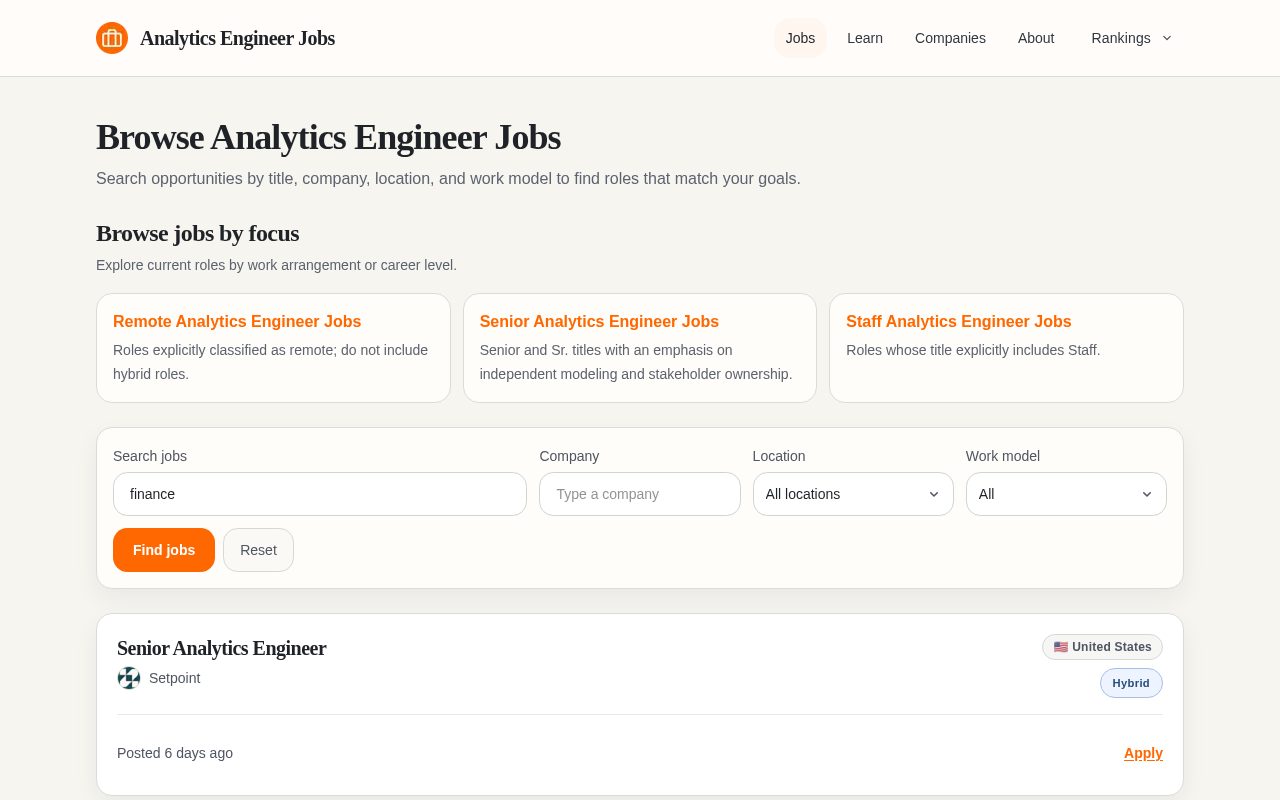
A finance keyword search on Analytics Engineer Jobs, with each result showing location and work model.
Clean aging models save finance hours at every month end, and they make a strong example to talk through in an interview.