

When a shift changes, which version did staff review? An Insacheck feature review
Editorial scope: this is a brand-commissioned review of published product information and a dated implementation snapshot, not a customer testimonial or a live deployment test. Reviewed on 28 October 2026. The examples below are hypothetical.
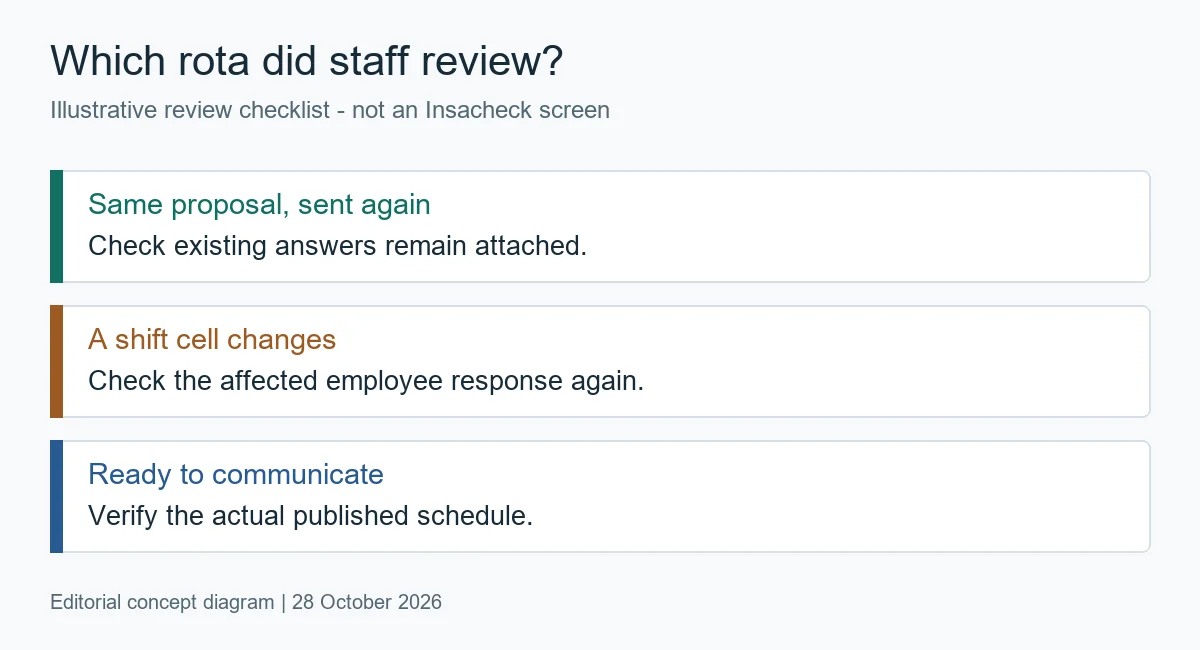
Original editorial concept diagram; not a product screenshot or test result.
A rota can look settled while its review history refers to something else. A supervisor moves Friday's late shift, but the spreadsheet beside the rota still says that everyone agreed on Monday. The useful question is not simply how many people replied. It is which arrangement those replies describe.
Insacheck is worth examining through that narrower question. Its scheduling materials distinguish preparation, staff review and publication. The implementation snapshot supplied for this review also associates a staff response with a particular roster revision. That is more informative than a single acknowledgement flag attached to an entire month.
Start with a version, not an approval percentage
Consider a hypothetical repair desk with six employees. The manager prepares next month's shifts and sends a proposed roster. Four people agree, one objects and one has not answered. Those three categories tell different operational stories: silence is not agreement, and an objection is not merely a missing response.
Now move one person's Friday shift from morning to evening. The earlier agreement should not be presented as confirmation of the revised arrangement. In the reviewed implementation, responses are revision-linked, and the draft-save path includes response-reset logic for the employees whose shift cells change, rather than indiscriminately clearing everyone's answer. Sending the same proposal again is treated differently: a repeated send is not intended to erase answers already received.
That distinction is the main strength of this design. It separates a reminder to review the same plan from a request to review a changed plan. It does not establish that every company has enabled the same workflow, or that every software release behaves identically.
A small acceptance checklist
Before relying on this in a real team, an administrator should run a controlled test with non-sensitive example data:
- Prepare one clearly identifiable department and month. Check that the operator has permission to publish for that scope.
- Send a proposal and verify what an employee can actually see in their own schedule.
- Record one agreement, one objection and one pending response. Inspect the aggregate progress without treating it as a public list of individual objections.
- Resend the unchanged proposal. Check whether the existing answers remain associated with that proposal.
- Change a shift, save the revised plan and inspect the response state before communicating a final rota.
- Verify the final published status separately from the response totals. Confirm what staff receive and see after publication.
These are proposed acceptance tests, not steps performed for this article. A screenshot of a high response rate alone would not establish that the revised schedule was reviewed or published correctly.
Three boundaries that deserve attention
Progress is not a personnel report. The reviewed aggregate model contains totals for agreed, objected and pending responses. It is not a basis for promising that managers can browse everyone's private reasons in that summary. If a concern needs individual follow-up, establish an appropriate private channel instead of copying it into a team-wide rota note.
A notification is not the record itself. Delivery settings and muted notifications can affect what reaches a device. The implementation also describes a schedule-screen entry point. During rollout, check that staff can find the proposal without relying exclusively on a push notification.
Do not invent a response deadline. The dated implementation explicitly notes that this review flow does not store a dedicated response deadline or accompanying message. A preferred-day-off collection deadline is a different field and should not be described as the roster-review deadline. If the business needs a cut-off, document the separate communication process and verify current product behaviour before promising automatic escalation.
Where this review leaves the decision
The practical benefit to evaluate is a more explainable connection between the rota and its responses, not a claim that software eliminates every scheduling disagreement. Staff acknowledgement should not be treated as a legal waiver, automatic compliance certification or proof that an understaffed shift is safe.
For a team comparing scheduling tools, the next useful demonstration is a deliberate edit after some staff have answered. Ask the administrator to show the affected revision, current response state and published schedule. That is a stronger purchasing question than asking whether the product has an approval button.
Source: Insacheck's shift scheduling guide. The revision-specific observations also use the supplied 21 October 2026 implementation snapshot, including its roster-review consent and send modules; those observations are not independent verification of a live customer environment.